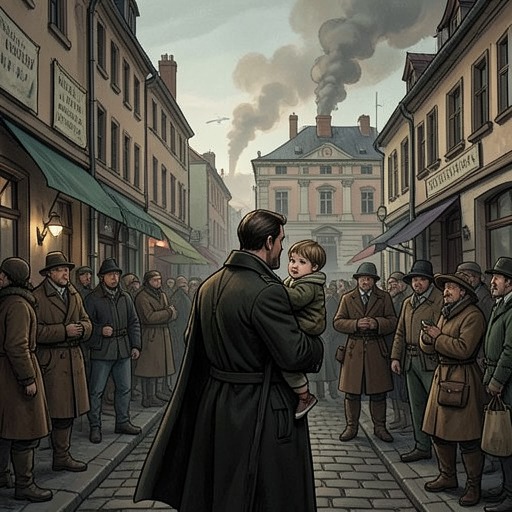
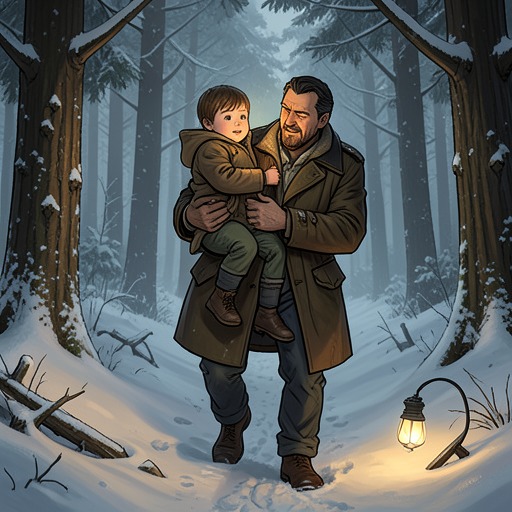
Sumner treats a wounded boy in Delhi
The North WaterPatrick Sumner’s encounter with a boy hiding in Delhi turns a promise of protection into a fatal failure. Injured and unable to move easily, Sumner finds the child in an abandoned room and tries to establish trust, offering safety in exchange for water and secrecy. When the advancing British troops draw near, he leads the boy out in search of help. Instead, a British soldier shoots the child, and Sumner’s attempt to tend to him comes too late.
The encounter in the abandoned room
Sumner reaches the room while limping through the besieged city with a broken leg. The high-walled, damaged surroundings give way to an interior containing little that could offer comfort or aid: dusty matting, a broken divan, an empty water jar, scattered household items, and an empty cupboard. In a smaller room beyond a curtained archway, a boy lies curled on a dirty blanket. Sumner cannot initially tell whether the child is alive. When he touches the boy’s cheek, the child stirs, wakes, and cries out in alarm.
Sumner hushes him and lowers himself to the floor, keeping his attention on the frightened child. Rather than approaching as though the boy were already willing to trust him, Sumner points to his injured leg and asks for water. He takes a coin from his pocket, discovers that he still has his gold ring, and shows it to the boy, gesturing for him to take it. The boy does not move to accept the ring; instead, he repeats the Hindustani word for water. The exchange begins with need and uncertainty, not with a shared language or an established relationship.
A promise made under siege
Sumner tells the boy to keep his presence secret and promises that, when the British soldiers arrive the next day, he will protect him. The child answers at length in Hindustani, which Sumner does not understand. The promise nevertheless gives the scene its immediate purpose: Sumner is not merely trying to find shelter for himself but presenting himself as someone who can keep the boy safe. The boy eventually nods and leaves the room.
The encounter recalls Sumner’s own childhood. When his parents were taken to a typhus hospital in Castlebar, he was left behind in an abandoned cabin; his mother promised they would return, but they did not. William Harper, a surgeon, remembered the missing child, came back the following day, and carried him out. Sumner remembers Harper’s wet boots and the warmth and steadiness of his presence. That recollection links the promise to the boy in Delhi with Sumner’s memory of having once depended on an adult who returned for him. In the present, however, Sumner can offer reassurance more readily than security.
After the boy comes back with a jug, Sumner drinks and uses the remaining water to clean his own injury. He makes splints from two pieces of firewood, takes his jackknife to shape them, and asks for the blanket the boy had been using. The boy brings it without speaking. Sumner binds the wood alongside his leg with strips of the blanket, struggling to finish the task because of the pain. This is the practical condition behind his promise: he intends to protect the child while himself injured and dependent on the boy’s assistance.
The attempt to reach the advancing troops
At first light, artillery fire resumes and moves closer as British troops advance through the city. Sumner tells the boy they should remain where they are and wait. The boy has found bark and what appear to be turnip leaves to chew. As gunfire and voices draw near, Sumner feels exposed and wants to hide, but the child looks to him. Sumner pulls himself upright, leans against the boy, and moves with him to the doorway.
From there, Sumner sees a dead Indian fighter and a British uniform beyond the alley. With the street filled by the disorder of battle, he urges the boy to move before the troops leave them behind. They hobble toward the shouting and gunfire, but the sounds recede as the battle advances elsewhere. At the thoroughfare, they find smashed masonry and corpses rather than a settled place of refuge. A British soldier emerges carrying a pistol and a sack of loot. Sumner calls to him for help. The soldier turns, notices the boy, and shoots him in the chest.
Death and the reversal of protection
Sumner lowers himself beside the boy and presses his hands against the wound, but the child dies within a minute. The scene does not allow Sumner’s promise to become protection: the soldier from whom he seeks help becomes the source of the boy’s fatal injury. The boy’s death is the decisive consequence of the attempt to reach safety, reversing the expectation Sumner had created when he told the child that British soldiers would arrive and he would keep him safe.
The episode also clarifies the limits of Sumner’s role. He is a surgeon, but here he is first a wounded man in need of water, then a caretaker attempting to move a child through a battlefield, and finally a witness trying to help after violence has already occurred. His earlier memory of Harper gives the promise emotional weight, while the outcome sharply distinguishes the rescue he once received from the aid he cannot provide in Delhi. The action ends not with escape or recovery but with the boy dead and the soldier still present, leaving Sumner’s effort to protect him defeated by the very military advance on which he had relied.